Pushing the Limits by Katie McGarry

20170409_172901-2.jpg

Published by Mira Ink 2012, 395 pages, £3.49

4.5 stars

It’s been a Katie McGarry week and I never want it to end. Thankfully, there are about five more (plus a novella) in this Pushing the Limits series. I have no idea why it has taken me so long to start it. The drama, passion and fiery energy the author brings to her characters warms me from each page. Unlike the Thunder Road series, there are no biker gangs, but focuses on domestic drama, bereavement and mental illness.

Echo and Noah are from two ends of the social spectrum (McGarry is at her best with opposite attraction). Echo was once popular girl, dance team member and on track for an art scholarship. But after the death of her older brother and a traumatic episode involving her mother, she becomes withdrawn and distant from everyone, hiding her inner and outer scars. She is also repressed by her controlling father and his new wife, who was embarrassingly her childhood babysitter.

Noah is the labeled ‘dodgy’ boy who sits at the back of class and lunch, involved with violence, drugs and hook-ups. After the death of his parents and the painful separation from his younger brothers, he has been through the mill of abusive foster care. He is someone who has given up on trust, especially from authority figures, and fights tooth and nail to get his brothers back. Both Echo and Noah’s days are filled with anger and silence. When a guidance councilor brings them together, their initial impression of each other- impressions created by gossip and stereotyping, gradually sift away to make room for their consuming attraction.

Their romance is so fierce, but the wounds from their problems are so raw, McGarry creates an exiting struggle of wanting and never wanting to be the characters. The plot is driven by the mystery of Echo’s memory, as she fails to remember the detail of her trauma. Echo’s mother suffers from bipolar disorder and she fears that she will also loose control and be accused of ‘craziness’. The story deals with the lack of understanding mental illnesses and how it is dealt with. As Echo’s memory comes back in fearful shards, she tries to loosen her father’s safety grips, while Noah does battle with society to reclaim his brothers. Everybody’s limits are tested as the characters challenge those that restrict them as well as pushing their inner scars to extremes. Long at times, the novel was an addictive whirlwind of fatal build-ups and made me look forward to my train journey after a trying day at work.

xxx

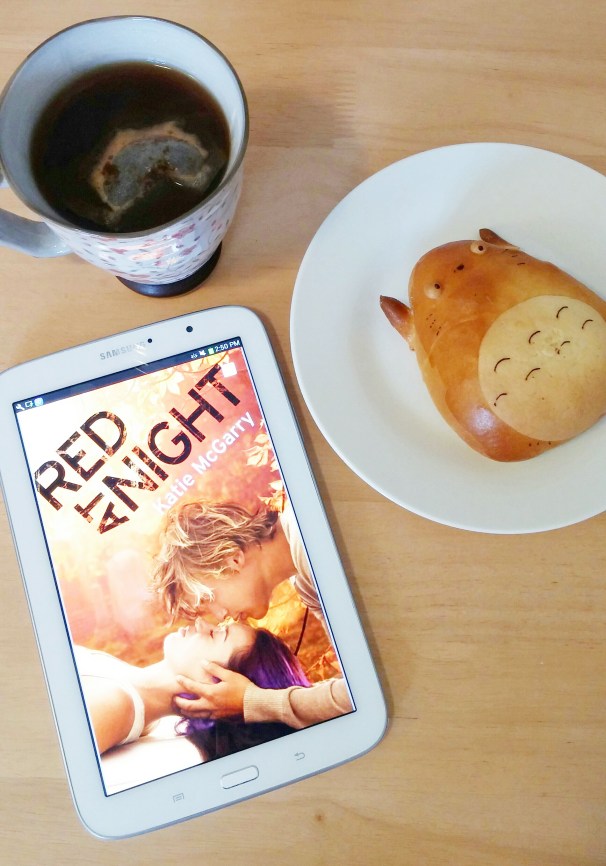
Long Way Home by Katie McGarry (Thunder Road #3) – and Red At Night (novella)

IMG_20170317_164030

Published by HQ, Feb 2017, 448 pages, £3.99

4.5 stars

Ever since Walk the EdgeI now seek Katie McGarry for addictive reads and fierce teen romances. This is the third book (hopefully not the last) in her Thunder Road series- think small town America, decaying diners and rival biker gangs. It’s necessary to read the earlier books as many events and characters are continued into this installment.

We follow the journey of Violet and Chevy, integral characters since the first book. They were childhood friends turned sweethearts, turned tense exes. After the death of her father, who was a member of ‘The Terror’ biker gang, Violet has had enough of the club who had been her home and family. Despite their vow to protect her, she wants nothing to do with them, their rules and way of life. The only problem is Chevy, her first love. He is devoted to the club, they mean family to him. A place where he belongs. And to prevent him from choosing between her and The Terror, Violet breaks it off with him, severing both their hearts.

The book opens with a chance meeting on an open road, which quickly turns into chaos when they are kidnapped by rival gang ‘The Riot’ and a plunged into a dangerous war between the two clubs. Mysteries of the past, secrets and betrayal spill out like heavy streams. Violet and Chevy try to navigate between these troubles whilst trying to control the flood of their own feelings for each other, which the author conveys so powerfully.

Violet and Chevy were not initially my favourite characters in the series, but McGarry encouraged my deep attachment to them. Her writing is punchy, honest and to the point. When a couple is confused about each other, it usually becomes tiring. This didn’t happen here. Passion pulsated out of each character’s thoughts and dialogue whether they were arguing or otherwise… Their relationship was continuous building, rather than a back-and-forth game.

This is the most dramatic book of the series, with a measured dose of danger and violence. The book also covers the sexist foundations of the club, which Violet challenges fiercely. Despite the club’s best intentions, Violet opens their eyes to double standards and unequal treatment. It is suggested that with her influence, Razor, Oz and Chevy are encouraged to become the new generation of the club, with a new set of rules. I think more could have been explored in this area as it transformed the book from a simple trouble-rescue plot to one about progression and change.

I need more Thunder Road books xxx


20170320_142112-2-2

Published by MIRA INK 2014, 83 pages, FREE

5 stars

As a free novella this is an amazing read. It had all the depth of a full length novel. Stella and Jonah are from different worlds. Stella is poor and has no choices in life than to drop out of school and take on a full-time job. Jonah is popular and college bound. He was part of a group of bullies who would torment her since she was young. Sometimes he laughed, sometimes he didn’t- still classified him as a bully. When a sudden accident and loss consumes him, he finds Stella as the only person who can help him. The two are drawn together with consequences and uplifting moments.

This novella is for charity and showcases The Goodie Two Shoes Foundation, which provides under-privileged children their own shoes of choice. It’s an inspiring cause that proves that something most people take for granted makes a huge difference to a child’s life and their future.

The Boy is Back by Meg Cabot

boysisback

Published by William Morrow, October 2016, 400 pages, £4.49

3 stars

Meg Cabot is my ultimate hero. She has a gift for creating vibrant characters in insanely hilarious scenarios within the stroke of a few sentences. Her romances are deep-felt and effortless. Her plots are fast-paced and addictive. The Boy is Back incorporates most of these qualities, but unfortunately falls short of being Cabot’s best work.

Cabot takes us to her favourite setting, small town Bloomville Indiana, where there is homely but close-knit chaos. The main characters are the boy who left and the girl who stayed. Reed Stewart is a pro golf star who turned his back on his past, including the parents that pushed him away and the girlfriend he let down. Becky Flowers is a successful business woman who worked hard to take over her father’s moving company. Her life revolves around organisation and control, especially when trying to forget a high school heart-break. When Reed’s parents run into financial trouble and alarming elderly episodes, he is pressured by his siblings to return for support. His reappearance triggers a rupture in the small community, who have already been buzzing about the Stewarts’ problems.

It’s a satisfying ‘confront the past’ story. There is all round fun with the siblings, their kids and citizens causing drama during an emotional period. As Reed tries to reconcile with his parents, old feelings for Becky get unlocked. Despite her control, Becky falls again for the boy who left and secrets are revealed.

This novel is written entirely through social media messages, emails, diary entries and letters. This creates a light read and upbeat pace, with each chapter being an energetic change. However, much of the depth to develop the romance and character growth is lost. The reader only experiences things on the surface and are prevented from being entirely involved. The Boy.. is the ideal read to unwind and amuse yourself, but nothing too deep.

BLOG TOUR: Before The Rains by Dinah Jefferies

20170127_172026-2

Published by Penguin UK, 23rd February 2017, 416 pages, £7.99 

3 stars

I am an avid follower of Dinah Jefferies, thanks to The Tea Planter’s Wife and even more so after the beautiful The Silk Merchant’s Daughter. Before the Rains is another installment about a plucky young woman overcoming personal struggles during the tumultuous period of her exotic setting and, of course, getting swept by a complicated romance.

Its 1930, Rajputana, India,  Eliza Fraser is a young widow and aspiring photojournalist with the first big job of what she had been told was an impossible career. She is sent on behalf of the English Government to an Indian princely state to capture images of the royal family, the first ever English woman to enter its impenetrable palace walls. Having lived in India as a young girl, she has a soulful connection to the country which only blossoms when she meets Jay, the Prince’s handsome and distant brother. Eliza enters the palace carrying her unresolved problems related to her father’s death in India, consuming guilt over her husband’s death and the alcoholic mother she left in England. Meeting Jay, who begins by being attractively disagreeable, helps her uncover mysteries of her past but throws her into a buffer position, having to navigate between England’s controlling grip and the might of Indian monarchy.

I wasn’t absorbed in this story as much as I was with Silk Merchant, the premise was not as heart-poundingly gripping for me. There is no question that the author delivers another vivid time portal, a VR version of prose. She captivates the reader’s senses with stunningly rich descriptions that read smoothly rather than in dense clumps. For about a week, I was in 1930s India, walking the shadowy halls of the palace with Eliza and smelling cardamon or riding into the dusty landscapes with Jay.

Yet the main structure of the plot was predictable but not in a comforting and satisfying way. The way events unfolded were far-fetched and felt more like the author connecting loose dots to summon meaning about fate and destiny. Some of the other characters felt like soap-opera stereotypes- the evil royal advisor, the long lost sibling. The relationship between Eliza and Jay had its sweeping and heady moments, but its whole appeal was of a forbidden romance guarded by race and ancient laws, hardly something memorable and absorbing.

Many thanks to Penguin for my review copy, eagery awaiting another Dinah Jefferies world xxx


20170126_084317-2

Caraval by Stephanie Garber

caraval
A gem

Published by Hodder & Stoughton, 31st Jan 2017, 416 pages, £6.99

4.5 stars

Remember it’s only a game

I was very impressed with this absolute star of a debut. It’s juicy, mind-twiddling plot made me feel like I had entered one of my dreams. This is a story about Scarlett and Tella, two oppressed young sisters living in fear of their abusive father.  Ever since she was a child, Scarlett had wanted to join the spectacular show called ‘Caraval’. This is a once in a year mystery game where the audience take part, gathering clues and interacting with actors to solve it. This game is so popular that participants have to be invited to play by the elusive game-maker ‘Legend’, who is surrounded by a smog of rumours and scandals. The show also has a reputation of danger and excess when players become too involved and forget that it is all fake. There is also a connection with ‘Legend’ and Scarlett’s family and a secret involving the mother that left them-another reason why Scarlett longs to be closer to Caraval.

Scarlett’s long awaited invitation finally arrives, at a time when her father’s tyranny is on full steam. With the help of a dashing but strange sailor Tella befriended, they both manage to escape. But as soon as they arrive at ‘Caraval’, Tella goes missing. Scarlett soon discovers that her sister is the mystery of this season’s game, with Scarlett desperately wading through an unreal world to find her. As she becomes more involved in the game, she too believes in its reality. She begins to piece together links to her family history and fears for her sister’s life. As stabs of danger begin to threaten her, I also started to take the game seriously.

Julian, the mysterious sailor, is not only heroic, charming and kind. He is unpredictable, untrustworthy, which means he is undoubtedly exciting. He has an intensity and sensitiveness that irrevocably attracts Scarlett, despite her base instincts. He alone stays by her side throughout the game and becomes a pillar of support through the madness. However, the more Scarlett opens her heart to him, the stranger his character becomes and the more involved he is with the game.

The setting of ‘Caraval’ felt like a recurring sub-conscious about being lost or trying to find something that’s always out of reach. The author was spot on with the irrational trickling of time- sometimes speedy, sometimes painful, like walking through honey. Tella was always frustratingly in the distance but never fully seen. Events unfolded like a slow moving kaleidoscope with strange characters popping up and then melting away. This is by no means a chaotic sequence of plot. The author controls and contains the game enough to lure the reader with keyholes of revelation. But just when Scarlett gets close to unmasking a clue, it changes. It keeps morphing right to the ending sentence, just when we think the game is over, a new one has begun.

Can. not. wait. for. sequel.

Many thanks to Hodder for my review copy!

xxx

A Quiet Kind of Thunder by Sara Barnard

quietthunger

Published by Macmillan, 12 Jan 2017, 320 pages, £4.00

4 stars

This was a very sweet story which I will remember for a while. A few months ago I read The Problem With Forever by Jennifer L. Armentrout, which was about a girl who had trouble speaking caused by trauma during an abusive childhood. That was when I realised the explosive power that rested in a story covering the topic of speech and the deep hold it had for me as a reader. As a naturally quiet person, as I am sure many readers are, I engaged with some of the mania and the injustice that shakes a character who is unable to express themselves through speech. Sara Barnard’s heroine, Steffi, is diagnosed as a selective mute with social anxiety. She begins the novel in silent but courageous agony against the mean girls, which was when I knew I was going immerse myself in her world.

The author’s writing flows very easily, her characters blossoming effortlessly that I had trouble switching off the kindle. You know you have a winner when you’re reaching for the book with just 5 empty minutes to fill. In fact, this book stole my attention from another, one that I was anticipating for a few months.

The MCs clicked well. Steffi is introduced to Rhys, a new student who is also deaf. She has been asked to look after him as she had some basic knowledge of sign language. They are immediately drawn to each other. Their romance isn’t as powerful as many of the current YAs out there, and especially if I am comparing it to The Problem with Forever. It was sweet and sensitive.

He thinks you’re sunshine.

Rhys is certainly an appealing, mature and witty love interest. The story focuses on happens after they share their first kiss and how they navigate themselves through a world that is clearly against their condition. When things get tough Steffi finds herself being pulled back into a internal wormhole that she suffers during the darker days of her uncontrollable silence. This book is about her being able to find light to pull herself out and the power of love certainly contributed.

Steffi and Rhys’ relationship wasn’t about finding a cure for Steffi, but more about two young hearts against the world as it would be for any pair strong willed teenagers whether they are deaf, mute or not.

Many thanks to Macmillan for a review copy xxx

The Hundred Lies of Lizzie Lovett

lizzielovett


4 stars

This book is fantastic! Its illuminating, delicate and quite haunting. I was impressed by this story about an alienated teenager who hates her small town life with its mean and mediocre inhabitants. Hawthorn Creely, a cleverly memorable name, sees the world differently believing in the extraordinary and the unbelievable. She has such a strong voice with a mix of angst, sorrow and dry humour, it immediately hooked me from the first few sentences. The extreme loneliness she feels, as she tries to reconnect with her former football star brother and battle the high school beauty queens who bully her relentlessly, effectively consumes the reader.

When a former popular girl disappears in the woods, Hawthorn feels contempt for how much it affects the town. Everybody comes to a stop, becomes obsessed and begins to mourn for this beautiful girl who once made Hawthorn feel like dirt. She sees Lizzie Lovett as her complete opposite. Even their names are different, Lizzie’s spells light, carefree, happy and most importantly adored. When the police struggle to find a trace, Hawthorn becomes curious, just as everybody starts to ‘move on’. Through some uncontrollable urge, she takes Lizzie’s old job as a waitress and becomes drawn to Enzo, Lizzie’s boyfriend. Despite everybody believing him a murderer, they form a connection as outcasts. Hawthorn tries to learn as much as she can about the former queen bee, and becomes fascinated and confused about how unspectacular Lizzie’s life had been before her disappearance.

Out of a jokey whim, Hawthorn wonders if Lizzie had turned into a werewolf. But the idea starts to become less impossible the more she thought about it. She manages to enlist Enzo’s help and they both start looking in the woods for any traces. This idea is so messed up, but slightly wondrous, because Hawthorn truly believes in magic. Even I started to believe. Not so much the actual werewolf, but the possibility of there being more answers in the world.

Enzo, artistic, grief-stricken and broken, was not the usual love interest. He remained elusive and didn’t convince me of his innocence. The dangerous path Hawthorn takes with Enzo and the mystery of Lizzie, which became stronger at each turn, truly enticed me. When we finally find out what happened, Hawthorn’s world turns upside down. Everything she believes in immediately unravels. She may believe in fantasy but she was too focused on her own unhappiness and social isolation that she was blind to the experiences of those around her. The ending is uplifting as she comes to terms with this realisation.

I can see this being a movie.

Many thanks to Sourcebooks for my review copy xx


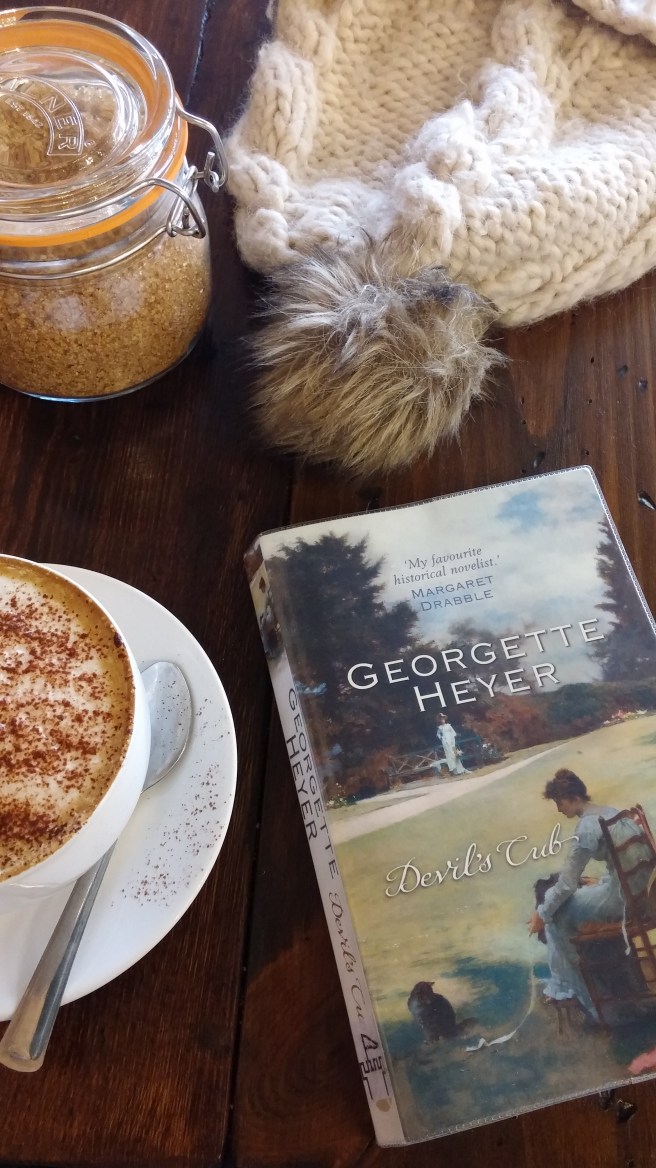
Devils Cub (1932) by Georgette Heyer

20161220_134431

2.5 Stars

I’ve been sampling a few vintage romances lately because I have been astounded with how they are so violent against women despite being a popular genre for women, see The Sheik (1919) and The Flame and the Flower (1972) as horrific examples.

I’ve read Georgette Heyer before; soft, sentimental regency dramas that have an uncanny knack to charm the reader and remain very much cherished to this day (you only have to walk into any library and see recent reprints taking over the whole book case). I chose Devil’s Cub (1932) because its been heralded as the more violent of the corpus. Apparently its part of a trilogy, but I didn’t notice this at all as the characters were re-introduced.

The story involves an abominably wild rake, Marquis of Vidal, who has earned the nickname ‘Devil’s Cub’ for his speedy chariot driving and ruthless killing of dueling opponents. In the first chapter, he shoots a highwayman and leaves him on the road without a thought. So this murderer plans on abducting the prettiest debutante of the ton to Paris to be his mistress. Unfortunately for him, this pretty, but brainless girl, has a smart older sister, Mary, who impersonates her sibling and goes to meet Vidal. Mary pretends that the trick was her sister’s idea, hopefully putting an end to their relationship and saving her sister from ruin.

Vidal, ever the beast, abducts Mary instead and threatens violence against her if she objects. Once they arrive in France the damage was done and Mary has no choice but to marry Vidal if she wants to return to England with her reputation intact. The alternative is to find employment at a genteel household, which she of course prefers. For some reason, Vidal becomes very possessive of her and refuses to let her leave him. The relationship is far from ideal. At this point, I wasn’t exactly drawn to their ‘romance’. I did warm to Mary, who is your typical plucky ‘plain Jane’ seeing right through Vidal’s hysterics, as well as being dignified and kind.

In the mean time there is added drama with Mary’s mother, who is delighted and persuading Vidal’s mother, a hot headed French woman, that a marriage must happen. Vidal’s mother rushes to France to put an end to the affair, followed by Vidal’s father, a once legendary rake in his day. Vidal and Mary get stickily entangled with another couple, Vidal’s cousin Juliana and her betrothed, who she plans on marrying secretly in France.

Despite the fairly entertaining mess described above, which heightens towards the end in a sword fight, the book is filled with very lengthy dialogues on topics like the rules of card games and social positions. Vidal and Mary have very few interactions, and most of them abusive on the side of Vidal except for the one occasion Mary draws a pistol, so I am not entirely sure how they fall in love. However, for some reason Heyer pulls off a satisfying ending which might have resulted from a balance between still dialogue and dangerous scenes.

20161218_130510

Holding up the Universe by Jennifer Niven

img_20161210_160544
Season Greetings

Published by Penguin, April 2016, 391 pages, £3.99

3.5 stars

This is another precious story from Jennifer Niven. I was a little apprehensive, because I saw some mixed reviews. If you were an avid worshipper of All the Bright Places (who wouldn’t be), you would also enjoy this, but it isn’t of the same calibre. We can all agree All the Bright Places is an incredibly special and powerful story. Holding up the Universe is just as endearing, but lighter. It will touch you, but won’t knock you out.

Again, Niven hands to us two stellar characters with moving problems. Libby is a girl who used to be ‘America’s Fattest Teen’ and had to be cut out of her house and hospitalized. After years of isolation and recovery, she returns to high school and tries to get her life back on track. When I say ‘recovery’, I don’t mean that she becomes sparkly thin and all is well. She has reached a size where most still call over-weight, but she is comfortable, has climbed over her eating disorder and doesn’t plan on losing anymore. She continued to surprise me. Her rock hard integrity and courage, the way she stands up for herself when the trolls inevitably descend, demands respect. She is a natural friend to the reader and at times I found myself laughing with her. Niven addresses all the dimensions of weight-shaming and bullying with clarity and taste. This is obviously someone who understands that moment when you are confronted with a dark irrational force of hate, or people who are just plain shitty.

Jack is a boy who seems to cruising through high school smoother than most. He’s popular, has the on-off girlfriend others fear, and is friends with the loud guys. He is fairly fetching, as fictional boys go. His fierce determination and confidence switching to tenderness at perfect moments echo Finch, but unfortunately doesn’t outshine him nor exist solidly on its own.

His story begins with trouble for making out with his girlfriend’s cousin. It was dark, he was drunk, he wasn’t ‘technically’ attached and ‘boys will be boys’ right? The problem is, he really could not recognise whether it was his girlfriend or not. Jack has face-blindness, a condition I never knew existed and feel so enlightened that Niven has introduced me to it. Realising what he had when he was younger, Jack has tried to live with it and put up a fake bravado. I wondered why he never wanted to share his problem, but then realised it came from a scarier, deeper rooted issue of mistrust and fear in his society:

Better to be the hunter than hunted.

Soon, Jack’s walls of survival begin to crumble, and a secret of his father’s threatens to shake the bonds even more. It is clear he is entirely alone until he runs into Libby. A cruel joke brings them crashing together, and finally he begins to let down his guard. The two connect in a satisfying way. Their relationship developed very quickly for those who hate frustrating teases, but I wish there was more of a crackling tension. Unfortunately, their romance falls a little flat at the end where the plot was in need of harsher conflict and a swoonier reunion.

But the way Niven writes is amazing – her prose is scattered with pockets of soul-affirming dreams and hopes, but also whirl-pools of endless darkness. This isn’t just a story about weight and cognitive disorder, it’s about alienation, trust and acceptance. We dance with the characters, struggle with them, and strive with them to achieve wholeness and enough strength to hold up a universe.

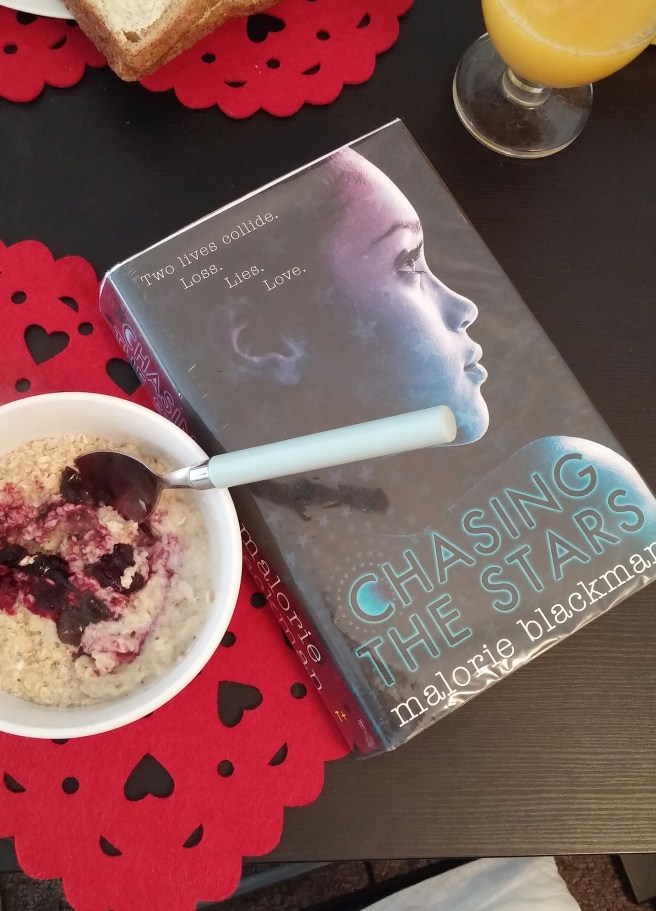
Chasing the Stars by Malorie Blackman

20161106_110311-2.jpg

Published by Penguin, April 21st 2016, 496 pages, £5.99

3.5 Stars

Ever since I read a positive review in Guardian Books a few months ago, I had wanted to get my hands on a copy.  A teen spin on Othello set in space really it hit the right note. It had a tall order, so I was curious to see if it lived up to the challenge.

Unfortunately, the beginning almost put me off. Why oh why does the Asian friend have to be a plant geek?? And the dated slang made me cringe- ‘fit’, ‘out of order’. To the non-Brits, I had heard these words when I was in high-school, ten years ago. And the universal post-apocalyptic greeting was ‘Nihao’ which I found unoriginal and slightly offensive. I know it was meant to be profound but we get it the Chinese might be taking over... But thankfully there wasn’t too much of this and the cliche character didn’t feature very often, so I was able to ignore him. I concentrated on the rest of the book which I turned out to be quite thrilling and thought-provoking.

Olivia and her twin brother Aidan have lost their family from a deadly virus and are travelling alone back to Earth. They spot some people in a zone controlled by the Mazon, a cruel and violent species who are determined to destroy anything foreign, especially humans. This is the first time Olivia has had any contact with other people for three lonely years. She is determined to help them, despite Aidan’s caution. But when they join her ship, things get uncontrollably sticky. For one thing they were running away from Earth and ‘The Authority’ which is its supreme ruler and refuse to explain anything. This suggests that there all may not be as it seems for the home Olivia is returning to. Despite Olivia’s help, a few members fail to recognise her as captain because of her being a teenage girl. As they are still within Mazon territory, they have to work together until the threat passes. But throughout the journey, members mysteriously die. Blackman kept me guessing the whole time who the murderer was. I love a good whodunnit.

Olivia instantly develops a bond with Nathan, the son of their leader. Their relationship may have happened a little fast, but I found it convincing and warming. I was quite surprised at how steamy the scenes were, so it is only suited for older teens and above. Aidan becomes naturally jealous of them, but there is something odd about him as well- something else I wanted to get to the bottom of. I really admired Olivia’s character. She is someone who places integrity as a priority, reacts quickly to disaster and is strong in resisting discrimination. Nathan is more of a standard love interest who is handsome, athletic and passionate.

There are many compelling conflicts all leading to the issue of prejudice and equality: the Mazon and their racial hatred, the Authority and its class system, the ageism and sexism towards Olivia. Blackman cleverly plots these topics into a slightly cheesy teen romance, transforming it into a novel essentially about what it means to be human.

This worked as a stand alone novel, but I really hope there is a sequel.