A Quiet Kind of Thunder by Sara Barnard

quietthunger

Published by Macmillan, 12 Jan 2017, 320 pages, £4.00

4 stars

This was a very sweet story which I will remember for a while. A few months ago I read The Problem With Forever by Jennifer L. Armentrout, which was about a girl who had trouble speaking caused by trauma during an abusive childhood. That was when I realised the explosive power that rested in a story covering the topic of speech and the deep hold it had for me as a reader. As a naturally quiet person, as I am sure many readers are, I engaged with some of the mania and the injustice that shakes a character who is unable to express themselves through speech. Sara Barnard’s heroine, Steffi, is diagnosed as a selective mute with social anxiety. She begins the novel in silent but courageous agony against the mean girls, which was when I knew I was going immerse myself in her world.

The author’s writing flows very easily, her characters blossoming effortlessly that I had trouble switching off the kindle. You know you have a winner when you’re reaching for the book with just 5 empty minutes to fill. In fact, this book stole my attention from another, one that I was anticipating for a few months.

The MCs clicked well. Steffi is introduced to Rhys, a new student who is also deaf. She has been asked to look after him as she had some basic knowledge of sign language. They are immediately drawn to each other. Their romance isn’t as powerful as many of the current YAs out there, and especially if I am comparing it to The Problem with Forever. It was sweet and sensitive.

He thinks you’re sunshine.

Rhys is certainly an appealing, mature and witty love interest. The story focuses on happens after they share their first kiss and how they navigate themselves through a world that is clearly against their condition. When things get tough Steffi finds herself being pulled back into a internal wormhole that she suffers during the darker days of her uncontrollable silence. This book is about her being able to find light to pull herself out and the power of love certainly contributed.

Steffi and Rhys’ relationship wasn’t about finding a cure for Steffi, but more about two young hearts against the world as it would be for any pair strong willed teenagers whether they are deaf, mute or not.

Many thanks to Macmillan for a review copy xxx
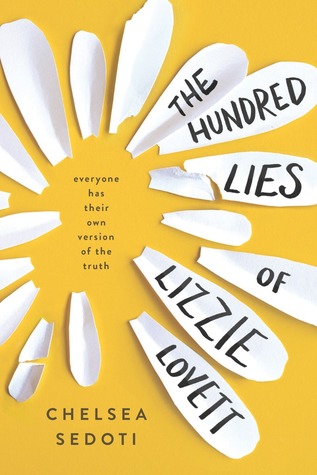
The Hundred Lies of Lizzie Lovett

lizzielovett


4 stars

This book is fantastic! Its illuminating, delicate and quite haunting. I was impressed by this story about an alienated teenager who hates her small town life with its mean and mediocre inhabitants. Hawthorn Creely, a cleverly memorable name, sees the world differently believing in the extraordinary and the unbelievable. She has such a strong voice with a mix of angst, sorrow and dry humour, it immediately hooked me from the first few sentences. The extreme loneliness she feels, as she tries to reconnect with her former football star brother and battle the high school beauty queens who bully her relentlessly, effectively consumes the reader.

When a former popular girl disappears in the woods, Hawthorn feels contempt for how much it affects the town. Everybody comes to a stop, becomes obsessed and begins to mourn for this beautiful girl who once made Hawthorn feel like dirt. She sees Lizzie Lovett as her complete opposite. Even their names are different, Lizzie’s spells light, carefree, happy and most importantly adored. When the police struggle to find a trace, Hawthorn becomes curious, just as everybody starts to ‘move on’. Through some uncontrollable urge, she takes Lizzie’s old job as a waitress and becomes drawn to Enzo, Lizzie’s boyfriend. Despite everybody believing him a murderer, they form a connection as outcasts. Hawthorn tries to learn as much as she can about the former queen bee, and becomes fascinated and confused about how unspectacular Lizzie’s life had been before her disappearance.

Out of a jokey whim, Hawthorn wonders if Lizzie had turned into a werewolf. But the idea starts to become less impossible the more she thought about it. She manages to enlist Enzo’s help and they both start looking in the woods for any traces. This idea is so messed up, but slightly wondrous, because Hawthorn truly believes in magic. Even I started to believe. Not so much the actual werewolf, but the possibility of there being more answers in the world.

Enzo, artistic, grief-stricken and broken, was not the usual love interest. He remained elusive and didn’t convince me of his innocence. The dangerous path Hawthorn takes with Enzo and the mystery of Lizzie, which became stronger at each turn, truly enticed me. When we finally find out what happened, Hawthorn’s world turns upside down. Everything she believes in immediately unravels. She may believe in fantasy but she was too focused on her own unhappiness and social isolation that she was blind to the experiences of those around her. The ending is uplifting as she comes to terms with this realisation.

I can see this being a movie.

Many thanks to Sourcebooks for my review copy xx


Heartless by Marissa Meyer

heartless

Published by Macmillan Children’s, 9th February 2017, 464 pages, £5.59

3 Stars

I was so excited when I got my ARC of this, but unfortunately I did not enjoy it as much as hoped. I read the entire Lunar Chronicles this summer and it blew me away, bumping Marissa Meyer up as one of my favourite authors. The premise of Heartless seemed interesting enough- an origin story of the Queen of Hearts from Alice in Wonderland. I’m not a huge Lewis Caroll fan. I love the Jabberwock poem, but I haven’t read Alice in Wonderland in years and I vaguely remember the Disney movie. So I haven’t been interested in reading Caroll adaptations in the past. I was only reading this because of the author. I thought it was going to be like Fairest, the origin story of the evil Queen Levana in the Lunar Chronicles, tragic and fascinating.

Before she became a blood thirsty loon, Catherine Pinkerton was once a young vivacious woman who dreamed of opening her own bakery. But being the daughter of nobility, she was forced into a marriage with the tiny air-headed King of Hearts who was unfortunately besotted with her. She meets Jest, the King’s new mysterious court entertainer, who introduces her to new ideas, worlds, and most importantly, freedom. They enter a secret romance despite the inevitable danger. Meanwhile the Kingdom is being terrorised by vicious monsters with no hope of being vanquished.

I was quickly enchanted by Meyer’s world building which was beautifully and cleverly written. Magic, wonder and intrigue filled each description, from lemon trees that grow from dreams to dancing lobsters. There are so many allusions to Caroll’s creation, which was a nice unearthing of my childhood memories. Familiar and new characters slip in together naturally. Catherine is a very passionate and warm character. Her struggle for independence, which evokes Victorian female oppression, is very endearing.

However, I’m afraid this is where my interest ends. My reading of this book took two months, way longer than I anticipated. Instead of racing through to the end as I did the Lunar Chronicles, I kept getting distracted by other books. I had to ask myself why it almost went into a slump pile, despite having so much promise? I think at the end of the day, when you take away all the beautiful (and sometimes heavy) descriptions, which is primarily adapted from other works, you are left with a singular story line: a young girl with a dream who is forced to abandon it. I’m not saying this story is too simple, but in this case it doesn’t survive. The romance between Catherine and Jest developed too slowly and just wasn’t strong enough. This resulted in the shift in Catherine’s character at the dreaded ending being quite displaced.

Perhaps it belongs to more devoted Caroll fans. The only reason I am not giving it 2.5 stars is because of the beautiful writing which is undeniably impressive. I will, of course, still look forward to more of Marissa Meyer’s work.


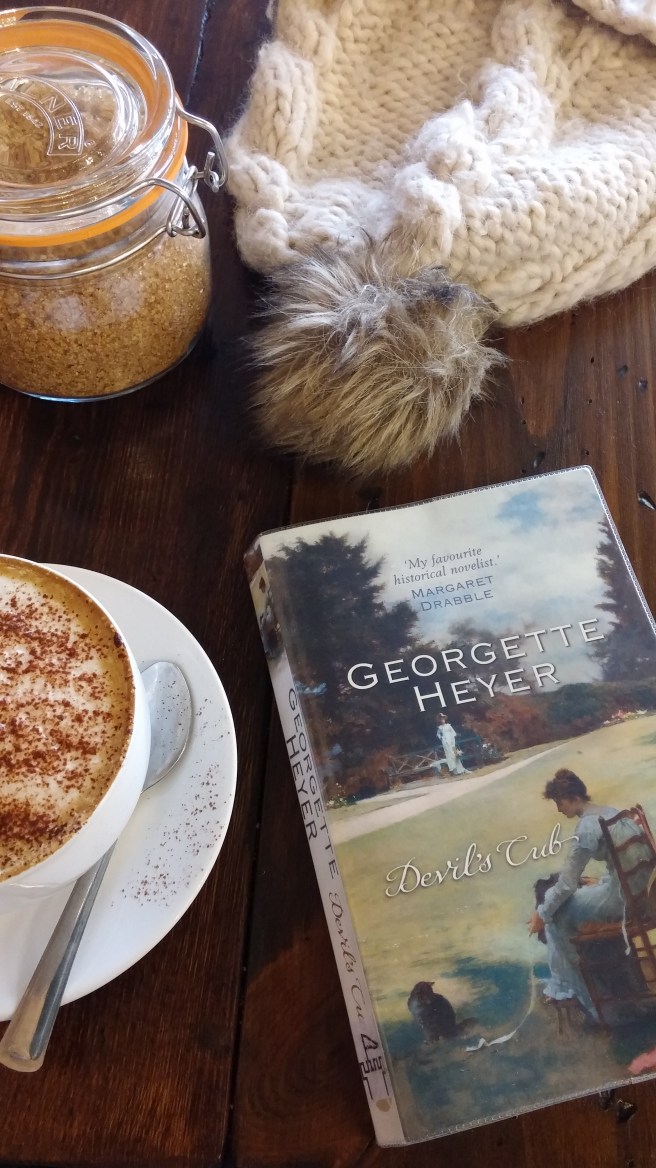
Devils Cub (1932) by Georgette Heyer

20161220_134431

2.5 Stars

I’ve been sampling a few vintage romances lately because I have been astounded with how they are so violent against women despite being a popular genre for women, see The Sheik (1919) and The Flame and the Flower (1972) as horrific examples.

I’ve read Georgette Heyer before; soft, sentimental regency dramas that have an uncanny knack to charm the reader and remain very much cherished to this day (you only have to walk into any library and see recent reprints taking over the whole book case). I chose Devil’s Cub (1932) because its been heralded as the more violent of the corpus. Apparently its part of a trilogy, but I didn’t notice this at all as the characters were re-introduced.

The story involves an abominably wild rake, Marquis of Vidal, who has earned the nickname ‘Devil’s Cub’ for his speedy chariot driving and ruthless killing of dueling opponents. In the first chapter, he shoots a highwayman and leaves him on the road without a thought. So this murderer plans on abducting the prettiest debutante of the ton to Paris to be his mistress. Unfortunately for him, this pretty, but brainless girl, has a smart older sister, Mary, who impersonates her sibling and goes to meet Vidal. Mary pretends that the trick was her sister’s idea, hopefully putting an end to their relationship and saving her sister from ruin.

Vidal, ever the beast, abducts Mary instead and threatens violence against her if she objects. Once they arrive in France the damage was done and Mary has no choice but to marry Vidal if she wants to return to England with her reputation intact. The alternative is to find employment at a genteel household, which she of course prefers. For some reason, Vidal becomes very possessive of her and refuses to let her leave him. The relationship is far from ideal. At this point, I wasn’t exactly drawn to their ‘romance’. I did warm to Mary, who is your typical plucky ‘plain Jane’ seeing right through Vidal’s hysterics, as well as being dignified and kind.

In the mean time there is added drama with Mary’s mother, who is delighted and persuading Vidal’s mother, a hot headed French woman, that a marriage must happen. Vidal’s mother rushes to France to put an end to the affair, followed by Vidal’s father, a once legendary rake in his day. Vidal and Mary get stickily entangled with another couple, Vidal’s cousin Juliana and her betrothed, who she plans on marrying secretly in France.

Despite the fairly entertaining mess described above, which heightens towards the end in a sword fight, the book is filled with very lengthy dialogues on topics like the rules of card games and social positions. Vidal and Mary have very few interactions, and most of them abusive on the side of Vidal except for the one occasion Mary draws a pistol, so I am not entirely sure how they fall in love. However, for some reason Heyer pulls off a satisfying ending which might have resulted from a balance between still dialogue and dangerous scenes.

20161218_130510

Holding up the Universe by Jennifer Niven

img_20161210_160544
Season Greetings

Published by Penguin, April 2016, 391 pages, £3.99

3.5 stars

This is another precious story from Jennifer Niven. I was a little apprehensive, because I saw some mixed reviews. If you were an avid worshipper of All the Bright Places (who wouldn’t be), you would also enjoy this, but it isn’t of the same calibre. We can all agree All the Bright Places is an incredibly special and powerful story. Holding up the Universe is just as endearing, but lighter. It will touch you, but won’t knock you out.

Again, Niven hands to us two stellar characters with moving problems. Libby is a girl who used to be ‘America’s Fattest Teen’ and had to be cut out of her house and hospitalized. After years of isolation and recovery, she returns to high school and tries to get her life back on track. When I say ‘recovery’, I don’t mean that she becomes sparkly thin and all is well. She has reached a size where most still call over-weight, but she is comfortable, has climbed over her eating disorder and doesn’t plan on losing anymore. She continued to surprise me. Her rock hard integrity and courage, the way she stands up for herself when the trolls inevitably descend, demands respect. She is a natural friend to the reader and at times I found myself laughing with her. Niven addresses all the dimensions of weight-shaming and bullying with clarity and taste. This is obviously someone who understands that moment when you are confronted with a dark irrational force of hate, or people who are just plain shitty.

Jack is a boy who seems to cruising through high school smoother than most. He’s popular, has the on-off girlfriend others fear, and is friends with the loud guys. He is fairly fetching, as fictional boys go. His fierce determination and confidence switching to tenderness at perfect moments echo Finch, but unfortunately doesn’t outshine him nor exist solidly on its own.

His story begins with trouble for making out with his girlfriend’s cousin. It was dark, he was drunk, he wasn’t ‘technically’ attached and ‘boys will be boys’ right? The problem is, he really could not recognise whether it was his girlfriend or not. Jack has face-blindness, a condition I never knew existed and feel so enlightened that Niven has introduced me to it. Realising what he had when he was younger, Jack has tried to live with it and put up a fake bravado. I wondered why he never wanted to share his problem, but then realised it came from a scarier, deeper rooted issue of mistrust and fear in his society:

Better to be the hunter than hunted.

Soon, Jack’s walls of survival begin to crumble, and a secret of his father’s threatens to shake the bonds even more. It is clear he is entirely alone until he runs into Libby. A cruel joke brings them crashing together, and finally he begins to let down his guard. The two connect in a satisfying way. Their relationship developed very quickly for those who hate frustrating teases, but I wish there was more of a crackling tension. Unfortunately, their romance falls a little flat at the end where the plot was in need of harsher conflict and a swoonier reunion.

But the way Niven writes is amazing – her prose is scattered with pockets of soul-affirming dreams and hopes, but also whirl-pools of endless darkness. This isn’t just a story about weight and cognitive disorder, it’s about alienation, trust and acceptance. We dance with the characters, struggle with them, and strive with them to achieve wholeness and enough strength to hold up a universe.

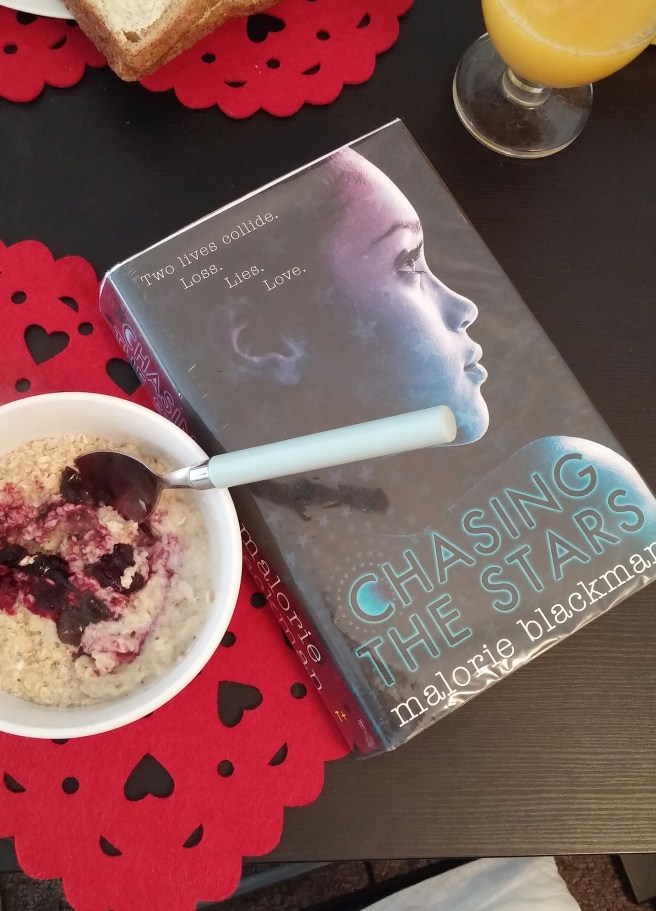
Chasing the Stars by Malorie Blackman

20161106_110311-2.jpg

Published by Penguin, April 21st 2016, 496 pages, £5.99

3.5 Stars

Ever since I read a positive review in Guardian Books a few months ago, I had wanted to get my hands on a copy.  A teen spin on Othello set in space really it hit the right note. It had a tall order, so I was curious to see if it lived up to the challenge.

Unfortunately, the beginning almost put me off. Why oh why does the Asian friend have to be a plant geek?? And the dated slang made me cringe- ‘fit’, ‘out of order’. To the non-Brits, I had heard these words when I was in high-school, ten years ago. And the universal post-apocalyptic greeting was ‘Nihao’ which I found unoriginal and slightly offensive. I know it was meant to be profound but we get it the Chinese might be taking over... But thankfully there wasn’t too much of this and the cliche character didn’t feature very often, so I was able to ignore him. I concentrated on the rest of the book which I turned out to be quite thrilling and thought-provoking.

Olivia and her twin brother Aidan have lost their family from a deadly virus and are travelling alone back to Earth. They spot some people in a zone controlled by the Mazon, a cruel and violent species who are determined to destroy anything foreign, especially humans. This is the first time Olivia has had any contact with other people for three lonely years. She is determined to help them, despite Aidan’s caution. But when they join her ship, things get uncontrollably sticky. For one thing they were running away from Earth and ‘The Authority’ which is its supreme ruler and refuse to explain anything. This suggests that there all may not be as it seems for the home Olivia is returning to. Despite Olivia’s help, a few members fail to recognise her as captain because of her being a teenage girl. As they are still within Mazon territory, they have to work together until the threat passes. But throughout the journey, members mysteriously die. Blackman kept me guessing the whole time who the murderer was. I love a good whodunnit.

Olivia instantly develops a bond with Nathan, the son of their leader. Their relationship may have happened a little fast, but I found it convincing and warming. I was quite surprised at how steamy the scenes were, so it is only suited for older teens and above. Aidan becomes naturally jealous of them, but there is something odd about him as well- something else I wanted to get to the bottom of. I really admired Olivia’s character. She is someone who places integrity as a priority, reacts quickly to disaster and is strong in resisting discrimination. Nathan is more of a standard love interest who is handsome, athletic and passionate.

There are many compelling conflicts all leading to the issue of prejudice and equality: the Mazon and their racial hatred, the Authority and its class system, the ageism and sexism towards Olivia. Blackman cleverly plots these topics into a slightly cheesy teen romance, transforming it into a novel essentially about what it means to be human.

This worked as a stand alone novel, but I really hope there is a sequel.

The Secret Letters by Catherine Law

20161022_132654_hdr-2-2

Published by Zaffre, Oct 2016, 377 pages, £3.99

”A heart-breaking tale of love and loss”- heart-breaking indeed.

Elderly Rose Pepper finds a few unopened letters by her long lost love hidden between the floorboards. She is forced to relive her past and confront the secrets she has kept from her two adult daughters. What we know from the start is that she had lived in Prague straight after the war but had to leave her beloved Krystof behind once communist forces began to take control. We also know that her two daughters have different fathers. Her youngest belongs to Krystof, but her eldest is from Will, a man they all agree to hate. If this is not the great secret then what is? And whatever happened to Krystof?

The rest of the book tells the story from the start, we meet a young Rose heading off to work as a land girl in Cornwall. She is engaged to Will, an older man who her parents adore. He is controlling, tempestuous and she struggles to break off the engagement. The only thing giving her hope is the chance to move away from them all and immerse herself into the countryside. The work is harsh and the people she lives with are also rough but good-natured deep down. Rose is someone you can feel slowly growing in strength and confidence. However, I did find her inability to leave Will, not just in their relationship but as a figure who dominates her life, very frustrating. This insecurity carries on throughout the rest of the novel with great consequences.

Will was a piece of work. I do admire authors who can create characters you loathe as much as ones you love. I cannot imagine any reader not hating him with a passion. So when Krystof arrives, he was like a ray of soft sunlight. Gentlemanly, sensitive and witty, Rose falls deeply for him. But dark shadows were constantly threatening their short-lived passion. The plot becomes more gripping and there was a nervous point where I thought everything was going to crumble. As the story moves to Prague, we get a temporary spell of happiness as the couple reunites, but punctuated by increasingly dark events from the communist army. As we knew from the start, Rose had to leave and then we return to her elderly self. When she finally opens the letters it was more of a confirmation than a revelation. I felt overwhelmingly sad and wished for something a little more uplifting. If you want a tear-jerker this is the one.

For more on Catherine Law check out her tips on beating writer’s block!

Many thanks to Zaffre for my review copy

XXX

The Ex Factor by Eva Woods

the-ex-factor

Published by Harper Collins, 8 Sept 2016, 368 pages,  £7.99

4 stars

I started reading this during the final two days of my trip in Berlin. And I didn’t stop. I was glued to my kindle and didn’t really take any notice of what was going on around me. The usual sweat-faced and back-aching, return journey was a dream… 

Eva Woods’ (aka crime author Claire McGowan) writing is swift, twisty and enticing. Its a hilarious account of four thirty-somethings’ dating life in London. It got me grinning like a loon on holiday, and even more so when my brother thought I was reading ‘A History of The X-factor’ (song contest). Its very suited to Sex and the Citians or those who are general fans of light romance/ chick-lit. And of course its perfect for travel and holiday reading.

Four single friends, who have ties going back to school and Uni, get together and embark on a dating experiment to date each other’s exes. This girl group is the stereotypical Rom-Com assortment: wild-child Marnie who came up with the idea, comfortably single Helen who prefers nights in with her cat, smart and cynical lawyer Ani, and newly divorced and vulnerable Rosa.

It starts off as a ‘why not just grit your teeth and do it because nothing has actually been working and it could be fun’. But of course it spirals into chaos. 

I was a little cautious, because I have found in the past that chick-lit can get a bit too light for me. Little drama and mediocre characters become dull rather than soothing. But no, this book kept bringing in change, making the pace feel very snappy. It had constant switching between four very different POVs, new characters filing in, and changes in the plot. There are also lots of unresolved issues and mystery that keeps tension pulsing. What I liked most was how it dealt with jealousy and insecurity between friends. You know who I’m talking about- the friend who has got it all figured out, or the one who always looks effortlessly fantastic and is so fun and interesting.

So if you want a good laugh and time off with other people’s drama then here is the ticket.

I really don’t want to turn thirty…

Many thanks to Cara from HQ Stories for my review copy xxx


About the Author

Eva Woods lives in London, where she writes and teaches creative writing. She likes wine, pop music, and holidays, and thinks online dating is like the worst board game ever invented.

author-profile

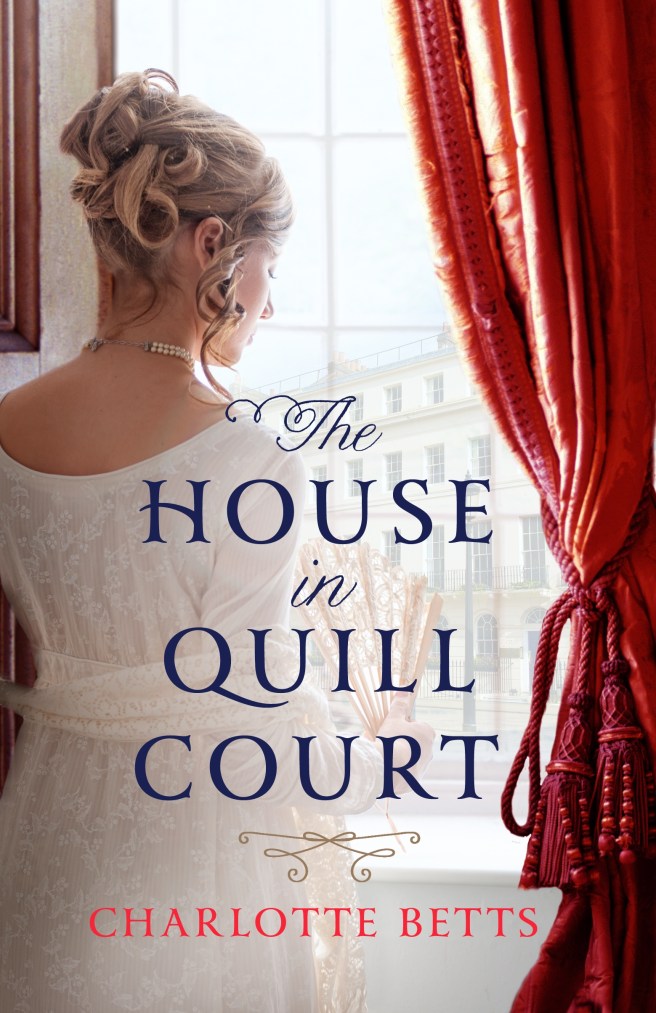
The House in Quill Court by Charlotte Betts


9780349404530.jpg

Published by Piatkus, 25th August 2016, 383 pages, 5.99

‘Romantic, engaging and hugely satisfying’

Katie Fiorde on The Apothecary’s Daughter

‘A highly-recommended novel of love, tragedy and the power of art’

Daily Mail on The Painter’s Apprentice

‘Full of passion and drama . . . I was captivated by this moving, heart-warming and beautifully woven story – gripping, atmospheric, eloquently told and full of rich detail’

Kate Furnivall on The Chateau on the Lake

2.8 stars

The beginning got the plot cogs churning nicely. Its 1813, imagine a young, noticeably handsome but hostile, man strolling in to inform your family that your father has been murdered. Not only this, but he secretly had another family in the city which he hopes for you to live with, to which this young man’s a part of. Shock and horror for Venetia, a young, ambitious woman as she experiences her whole privileged world smash against their elegant wall. We follow her family as they uproot themselves to London, meet the ‘others’ and overcome all the shame buzzing around. They also have to find a way to support themselves, so Venetia busies herself with re-opening her father’s furniture business. Jack Chamberlaine, the guy who broke the news, reluctantly helps her. He’s war-wearied, initially suspicious, but soon softens, and conveniently not a blood-relation. Together, they try to gather up the mess while something blossoms between them.

We also get POV chapters from Kitty, their maid, who accompanies them. Kitty is sweet and lively. She was bored with the village life she had, where the end point was to be married in a tiny shack with a bundle of babies. When she arrives, she runs into Nat, a good-looking street rat who is as fascinating as the city. He introduces her to a whole new world of women wrestlers, dangerous alley-ways and professional house burgling. So it was refreshing to get a change of story now and then. I grew to like Venetia and Kitty as pleasant characters. The main vein that connects to two is a mysterious mafia called King Midas that controls the neighbourhood and begins terrorizing their lives. He is also connected to the death of Venetia’s father. So the book gradually gets darker almost to the point of echoing Les Miserables.

As Kitty and Venetia begin to clash with King Midas and his cronies, the book unfortunately reaches a bit plateau 40-70% through. The pacing slows down and you’re basically living with the characters during their daily activities. I found this slightly mundane, but it suits those who enjoy soothing sagas. Those like me, who prefer heart-constricting romances and thrilling paces, will feel a little held back during this stage. Things pick up towards the end. There is a sneaky little twist which I didn’t see coming, and a good old fight scene. Kitty’s ending saddened me because seemed a direct result of class. Despite it being a fairly realistic portrayal, it seemed a bit typical of Victorian yarns and gives off the wrong attitudes if it intends for readers to be OK and accept it as a happy ending.

Many thanks to Piatkus for my review copy xxx


IMG_20160813_101641.jpg

About the Author:

Charlotte Betts began her working life as a fashion designer in London. A career followed in interior design, property management and lettings. Always a bookworm, Charlotte discovered her passion for writing after her three children and two step-children grew up.

Her debut novel, The Apothecary’s Daughter, won the YouWriteOn Book of the Year Award in 2010 and the Joan Hessayon Award for New Writers, was shortlisted for the Best Historical Read at the Festival of Romance in 2011 and won the coveted Romantic Novelists’ Association’s Historical Romantic Novel RoNA award in 2013. Her second novel, The Painter’s Apprentice was also shortlisted for the Best Historical Read at the Festival of Romance in 2012 and the RoNA award in 2014. The Spice Merchant’s Wife won the Festival of Romance’s Best Historical Read award in 2013.

Charlotte lives with her husband in a cottage in the woods on the Hampshire/Berkshire border.

www.charlottebetts.com | @CharlotteBetts1

For further information please contact Clara Diaz on 020 3122 6565 | Clara.Diaz@littlebrown.co.uk

BettsCharlotte.jpg


Walk the Edge by Katie McGarry (Thunder Road #2)

DirectIngest,
Seriously good


Published by Harlequin Teen, March 29th 2016, 448 pages, £7.99

When I was reading this, I tweeted that it was The Business. And I meant it. A few pages in and I was already going weeeeeheeeee! When I read Nowhere But Here, the first book in the Thunder Road series, I slipped into Katie McGarry’s style very easily. The story was exciting, the couple addictive to follow and crackling with attraction. Walk The Edge is just as good, if not better. This is a sequel/ spin-off. We pick up where we left off, but following one of Oz’s best friends Razor- silent, slightly scary, moody with issues, but totally smoldering at the same time. The reason I say spin-off is that I think it’s possible to read this without having read the first book. I actually forgot a few things that have happened and I still enjoyed it. If you want to be good, I would recommend reading Nowhere But Here first, because you get introduced to all the characters and the general background. All you need to know is that Snowflake is a small-town with an infamous biker gang called Reign of Terror, reputed for violence and debauchery. The gang freak the hell out of everybody and good girls are told to stay away. We are constantly reminded that the gang is ‘legit’, as they are hired as protection for delivery companies. But they are at war with another gang called The Riot, who are not so legit. So a lot of secrets and dodgy things have gone down in the past and since the first book.

20160501_111443_HDR~2

Razor runs into Breanna, one evening after school as she waits to be picked up. Breanna is the invisible, smartest girl in school. She is desperate to leave to a place where she can fit in. But there is also something special about the way her mind works. Her brain is forever solving a problem, and it won’t rest- not even to sleep- until it cracks it. She has always been taunted for her abilities to the point where she is sick of who she is. She is also 1 of 9 siblings who all bully her for being ‘perfect’- the injustice of it all really got me loving her.

The couple start off curious of one another. Despite being raised to fear the Terror gang, Breanna can’t stay away from Razor- of course she can’t. And in that first evening they meet, Razor sees something about her that he wants to protect. (Its pretty swoony that he already knows her name). That’s because Breanna becomes the target of some more bullying that starts off small but intensifies out of control. Razor is thrown into the mix and Breanna asks for his help. In return, Breanna will help him figure out the mysterious death of his mother- something else that keeps you hooked to the end. The couple are so unlikely but they work so well. They are the stereo-types everyone talks about at school but no-one really knows.

The book is all about image and prejudice; who you are and where you belong. And not forgetting powerful love! It will get you dizzy and sighing (inner-sighing if you’re in public like I always seem to be during the good bits). It’s also about unfair double-standards. Yet again, girls are the victims of cyber-bullying- to the point where they are branded and ruined. Breanna learns to turn her back to all the whispers and embrace who she is.

I’m still not sure if I am a fan of the Terror gang. I mean, the women of the members are part of a club called the Terror Gypsies, which sounds like a groupie. They can’t join and take part in the serious stuff- even though it affects their families. The members are part of a brotherhood which means they have mutual respect and protection, but there are strict rules so it also sounds like a cult. Also, we never find out what happens to Addison, Breanna’s friend, who is getting abused at home..?

Thanks to Cara at Mira for my review copy! Yay for book 3 coming up with Chevy and Violet’s story.

xx